
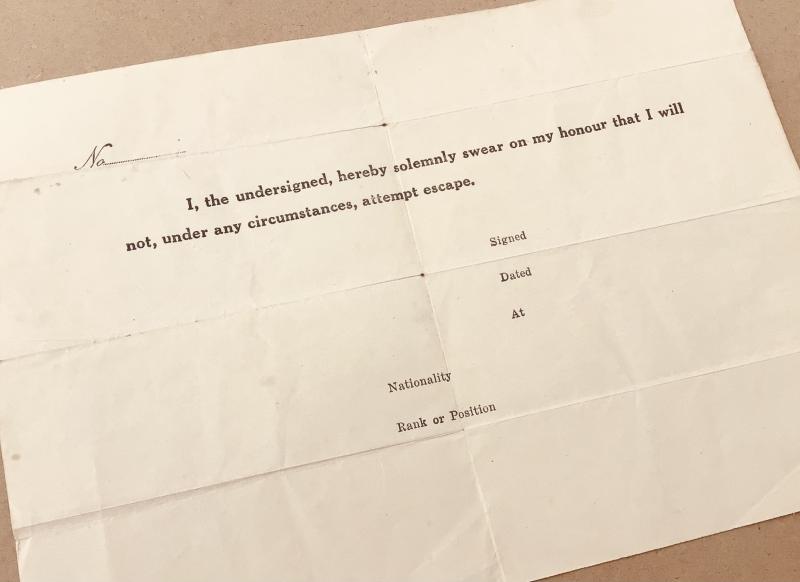
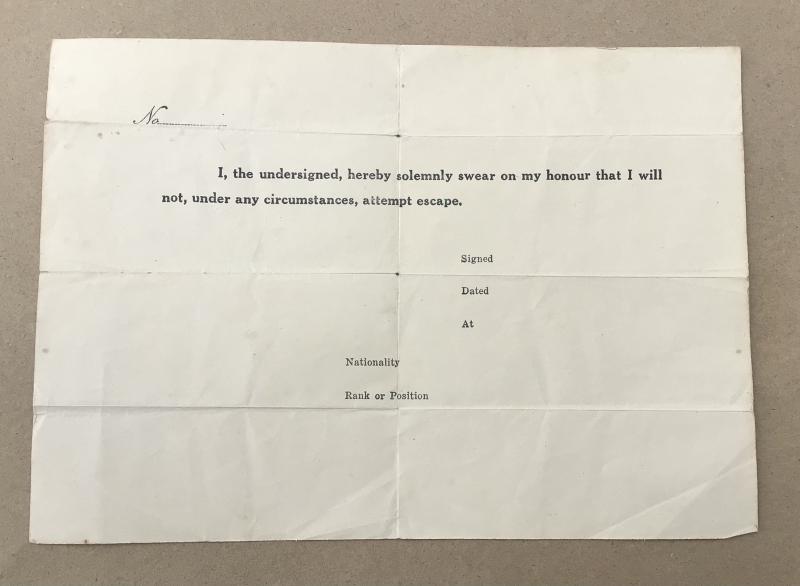
Rare WW2 Changi POW Camp " Selerang Barracks Incident Japanese Ordered " No Escape" Pledge.
On 30 August 1942, British and Australian prisoners-of-war (POWs) revolted against their Japanese captors in the Selarang Barracks camps in Changi, Singapore. The Japanese had recaptured four POWs who escaped from the camps, and required that the other prisoners sign a pledge not to escape. After they refused, they were forced to crowd in the areas around the barracks square for nearly five days with little water and no sanitation. The executions of the recaptured POWs failed to break the men. The commanders, however, finally capitulated on 5 September when their men started to fall ill and die from dysentery. Upon signing the pledge, the men were allowed to return to the barracks buildings.
Built in 1938, the Selarang Barracks was part of the Changi Garrison, a heavily fortified coastal defence where most of the British forces were based during the Battle of Singapore. The Selarang Barracks housed the 2nd Battalion Gordon Highlanders, a British Army infantry regiment which recruited its soldiers mainly from North East Scotland. The Royal Engineers and the 9th Coastal Artillery Regiment of the Royal Artillery were based in nearby Kitchener Barracks and Roberts Barracks respectively. After the British surrender of Singapore on 15 February 1942, Allied POWs were ordered by the Japanese to march to Changi for internment. As the British-built Changi Prison was already crowded with Allied POWs and civilians, the surrounding barracks including Selarang Barracks were used by the Japanese as a holding area for Australian and British POWs.
On 30 August 1942, as a pre-emptive measure, the newly arrived Japanese Commander General Shimpei Fukuye wanted the wholly British and Australian POWs interned at Selarang Barracks in Changi to sign a "No Escape Pledge" after the recapture of four escaped prisoners from Changi Prison earlier. The four escapees were Australian Corporal Rodney Breavington and Private Victor Gale, and British soldiers, Private Harold Waters and Private Eric Fletcher. The pledge reads: "I the undersigned, hereby solemnly swear on my honour that I will not, under any circumstances, attempt to escape." With three exceptions, everyone refused to sign, because the prisoners saw it as their duty to escape if they could. Under the Geneva Convention, POWs had the right to attempt to escape and they were not supposed to be punished if they were recaptured. However, at that time, Japan was not a signatory to the Geneva Convention although it was the signatory of the 1907 Hague Convention, which provided humane treatment of prisoners of war (POWs) and it had also signed the Kellogg-Briand Pact in 1929, thereby rendering its actions liable to charges of crimes against peace. General Fukuye was furious at the mass display of insubordination and the following day he ordered all prisoners, except the three who had agreed to sign, to congregate at the parade square in Selarang Barracks. What ensued was to become known as the "Selarang Barracks Incident".
The Selarang Barracks, originally built to accommodate 800 men, consisted of a parade ground surrounded on three sides by three-storey buildings. A number of smaller houses for officers and married couples were spread out in the spacious grounds. Nearly 17,000 men crammed into a parade ground of about 128 by 210 metres and in the surrounding areas. An Australian POW, George Aspinall documented the situation:
The first and most urgent problem we had to face up to was the lack of toilet facilities. Each barracks building had about four to six toilets, which were flushed from small cisterns on the roofs. But the Japanese cut the water off, and these toilets couldn't be used. The Japanese only allowed one water tap to be used, and people used to line up in the early hours of the morning and that queue would go on all day. You were allowed one water bottle of water per man per day, just one quart for your drinking, washing, and everything else. Not that there was much washing done under the circumstances.
When there were no signs of the POWs backing down on the third day, General Fukuye ordered the Commander of the British and Australian troops in Changi, Lt-Col E. B. Holmes and his deputy, Lieutenant Colonel Frederick Galleghan, to attend the execution of the four recent escapees: Breavington, Gale, Waters and Fletcher. One of the Australians, Breavington, pleaded to no avail that he was solely responsible for the escape attempt and should be the only one executed. Their executions were carried out by the Indian National Army guards with rifles on 2 September. The initial volley was non-fatal, and the wounded men had to plead to be finished off.
Despite the executions, the prisoners remained firm as the days ensued. Without food and little water available and coupled with latrine pits, kitchens and hospital beds crowded into an area of about a square kilometre, dysentery broke out quickly and the sick began to die. Realising that more would die needlessly, the prisoners' commanders decided that they and their men would sign the pledge "under duress". On 4 September, Lt-Col Holmes issued a written order to his men:
The requirement by the Imperial Japanese Army, issued under their Order No.17 dated 31 August '42 that all ranks of the POW Camp Changi, should be given the opportunity to sign a certificate of promise not to escape, has now been amended in a revised Imperial Japanese Army Order No.17 dated 2 September '42 to a definite order that all officers, NCOs, and Men of the POW Camp shall sign this undertaking. I therefore now order that these certificates will be signed by all ranks, and handed by Area Commanders to Command Headquarters by 1100 hrs on 5 September '42. The circumstances in which I have been compelled to issue this order will be made the subject of Selarang Special Order No. 3 which will be issued later.
As the Japanese were not familiar with British names, the POWs signed using false or meaningless names. One of the most common signatures among the Australians was that of folk hero Ned Kelly. After the signing was completed, the Japanese allowed the prisoners back to their former areas on 5 September.
Source: Wikipedia
Extremely fragile. Multiple fold marks and some minor tears along the folds. Unsigned example.
Just how many of these have survived. How many like this one was carefully folded up, lasted the test of time in the POW camps, brought back home and tucked away for another 80 odd years. .....just how many??
Code: 4795
295.00 AUD